
The Technology Behind IPTV
Delivered Over IP, Not Broadcast
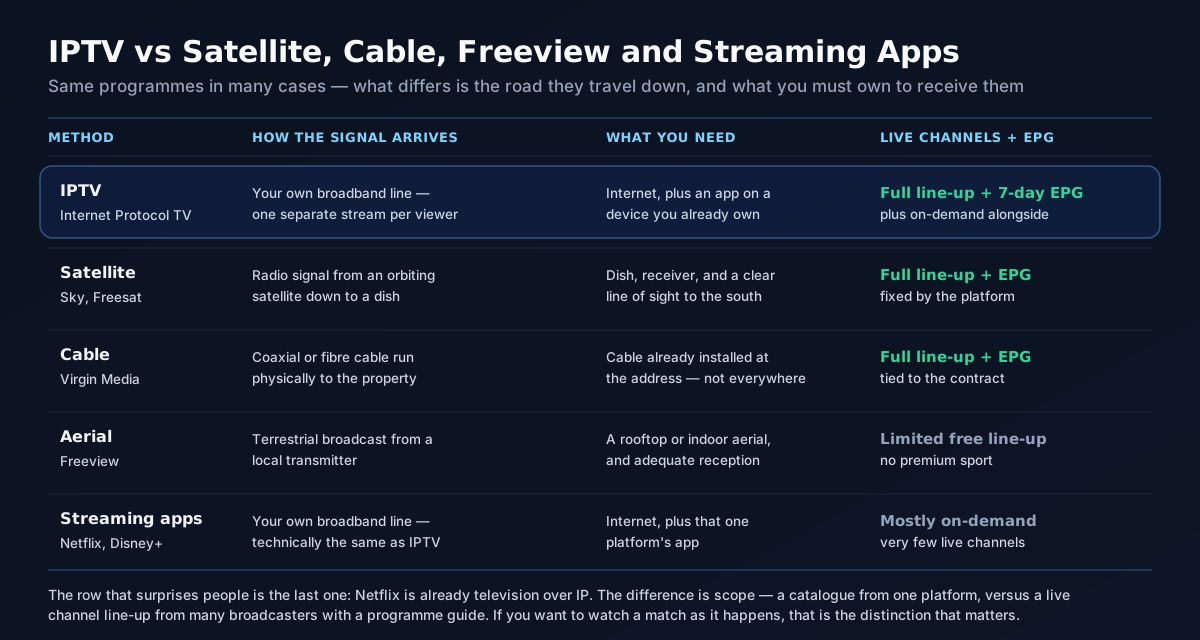
Traditional TV broadcasts one signal to everyone via aerial, satellite or cable. IPTV sends an individual unicast stream to your device over the same broadband that carries your web traffic.
Three Service Types
Live linear TV, video on demand, and time-shifted (catch-up) TV. Most UK IPTV services, ours included, provide all three from one subscription.
Xtream Codes & M3U
The two de facto standards for independent IPTV. Xtream Codes is an API that hands your player the full channel list and EPG; M3U is a playlist file listing each stream URL.
HLS & MPEG-TS Transport
Streams are typically delivered as HLS segments or MPEG-TS, encoded in H.264 or HEVC/H.265. HEVC is what makes 4K feasible at UK domestic broadband speeds.
EPG via XMLTV
The programme guide is a separate XMLTV feed the player merges with the channel list — which is exactly why some providers have full channel lists but patchy guides.
CDN & Load Balancing
Serious providers distribute load across multiple edge servers. Concurrency capacity, not channel count, is what determines whether a provider survives peak sports.
Types of Internet Protocol Television Provider in the UK
| Provider type | Examples | How content is licensed | Typical commitment |
|---|---|---|---|
| Telco IPTV | BT TV, EE TV | Direct broadcaster agreements | 18–24 month contract |
| Broadcaster IPTV | Sky Stream, Sky Glass, Now | Own and licensed rights | 18–31 months, or rolling on Now |
| Cable operator IPTV | Virgin Stream | Direct broadcaster agreements | 18 month contract |
| Free public-service IPTV | BBC iPlayer, ITVX, Channel 4 | Public service / advertising funded | None — free, UK geo-locked |
| Independent IPTV providers | Sportix Media and others | Reseller and distribution agreements | Prepaid, no contract |
| Public M3U playlists | Community-maintained lists | Generally unlicensed, unreliable | None — and largely non-functional |
Why Concurrency Is the Only Metric That Matters
Because broadcast television sends one signal to everyone, a million extra viewers cost a satellite operator nothing. IPTV is the opposite: every viewer consumes a dedicated unicast stream, so bandwidth and server cost scale linearly with concurrent viewers. That single architectural fact explains almost everything about how IPTV providers behave.
It is why the entire UK independent IPTV market strains at the same moments — Saturday 3PM kickoffs, Champions League nights, major PPV cards — and why a provider selling subscriptions at £1 per month must oversubscribe its servers to survive. Advertised channel counts are close to meaningless by comparison; 35,000 channels are trivial to list and expensive to actually serve at peak.
The signals that indicate real infrastructure are multi-server load balancing with failover, adaptive bitrate delivery so streams degrade rather than freeze, hardware HEVC support for 4K, and a maintained XMLTV guide. All four cost money to run, which is why they are the honest things to test on a free trial at peak time.
Frequently Asked Questions
All plans and prices are on one page
Every subscription length, connection count and price is listed together on our pricing page — from £10 for a single month up to £75, with the cheapest working out at £3.75/month on a 12-month plan. Nothing on this page overrides it.
Test the Infrastructure, Not the Marketing
Concurrency is the only claim that matters and the only one you can verify yourself. Claim a free 6-hour trial and use it during a Saturday 3PM kickoff.