
SportixMedia — UK IPTV subscription provider
🎁 Free Trial
📖 The Plain Definition

What Is IPTV? Internet Protocol Television, Explained

IPTV stands for Internet Protocol Television: television delivered over your broadband connection instead of from a satellite dish, a cable or a rooftop aerial. That is the whole definition — everything else is detail. This page covers the detail honestly: how the delivery actually works, how IPTV differs from cable, satellite, Freeview and apps like Netflix, what you genuinely need to run it, and where the legal line sits in the UK.

🎁 Claim Your 6-Hour Free Trial💰 View Pricing Plans
IP
Internet Protocol
15–25
Mbps Per Stream
0
Dishes or Aerials Needed
2
Open Standards (M3U, Xtream)
Internet protocol television explained — IPTV streaming over broadband to a TV device
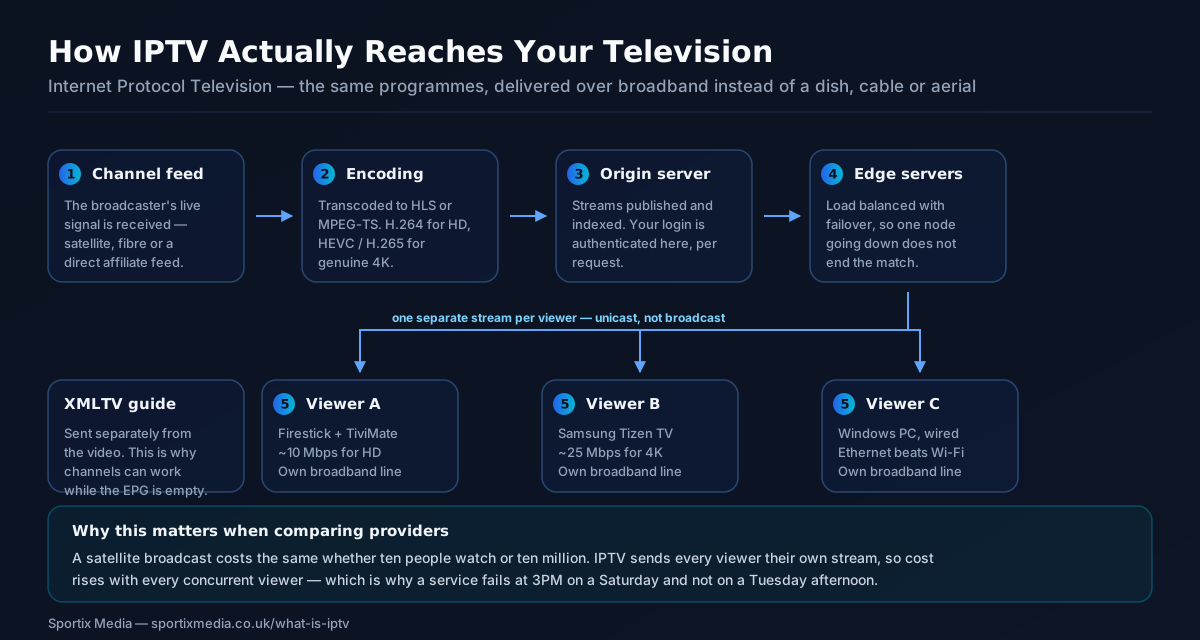
Diagram of the IPTV delivery chain: broadcaster channel feed, encoding to HLS or MPEG-TS, origin server, load-balanced edge servers, then one unicast stream to each viewer over their own broadband connection
Every viewer receives a separate stream. That single fact — unicast rather than broadcast — is why an IPTV service can be flawless on a Tuesday and fall over at 3PM on a Saturday.

Six Things That Define IPTV

🌐

It Is a Delivery Method, Not a Product

IPTV stands for Internet Protocol Television. The television content is identical to what a dish or aerial carries — what changes is the road it travels down. Your broadband line replaces the satellite feed.

📡

Unicast, Not Broadcast

A satellite transmits one signal to everyone at once. IPTV sends a separate stream to each viewer on request, which is why concurrency (how many people are watching) is the real cost driver in this industry.

🔗

Delivered as Credentials, Not Hardware

A legitimate IPTV service gives you an Xtream Codes login or an M3U playlist URL. You enter those into an app. There is no installer, no dish, and no box you are locked into.

📺

It Runs on What You Already Own

Any device that speaks Xtream Codes or M3U — Firestick, Samsung Tizen, LG webOS, Android TV, MAG, Formuler, iPhone, iPad, Windows PC or Mac. No proprietary receiver required.

📅

The EPG Is Separate From the Video

The programme guide arrives as an XMLTV file alongside the streams. This is why some services have channels that work but a guide that is empty — they are two different jobs, and the guide is the one providers skip.

⚖️

The Technology Itself Is Legal

IPTV is a protocol, and protocols are not illegal. BT Sport, Sky Glass and Now all use it. What determines legality is whether the provider holds distribution rights for what they carry — which is a question about the provider, not the technology.

IPTV Compared With Satellite, Cable, Aerial and Streaming Apps

IPTV Compared With Satellite, Cable, Aerial and Streaming Apps
How the signal reaches youWhat you needChannel model
IPTVYour broadband connection, one stream per viewerInternet + an app on a device you ownA full live channel line-up plus on-demand
SatelliteRadio signal from an orbiting satellite to a dishDish, receiver, line of sight to the southLive channel line-up
CableA coaxial or fibre cable to the propertyCable installed at the addressLive channel line-up
Aerial (Freeview)Terrestrial broadcast from a local transmitterRooftop or indoor aerialA limited free live line-up
Streaming appsYour broadband connection, one stream per viewerInternet + the appMostly on-demand, few live channels

What You Actually Need to Run IPTV

What You Actually Need to Run IPTV
RequirementRealistic minimumWhy it matters
Broadband speed15–25 Mbps stable per streamHD needs roughly 8–10 Mbps; genuine HEVC 4K needs around 25 Mbps
Connection stabilityEthernet preferred over Wi-FiBuffering is far more often jitter than raw speed
A deviceFirestick, Smart TV, Android box, phone or PCAnything that accepts Xtream Codes or an M3U URL
An appTiviMate, IPTV Smarters Pro, GSE or your TV's ownThe app is the player; the subscription is the content
CredentialsAn Xtream Codes login or M3U playlist URLThis is what a subscription actually consists of

Why the Definition Matters When You Are Choosing a Provider

Understanding that IPTV is unicast — one stream per viewer rather than one broadcast to everyone — tells you almost everything about how to judge a provider. A satellite broadcaster’s costs do not change when a million extra people tune in. An IPTV provider’s costs rise with every single concurrent viewer, which is why services degrade at 3PM on a Saturday and not at 3PM on a Tuesday.

That single fact is the reason we say repeatedly that the only test worth running is a peak-time test. Channel counts, 4K badges and the word “premium” are all free to claim. Holding a stable stream through a full 45 minutes of a blacked-out Saturday kickoff is not, because it costs the provider real capacity to deliver.

It also explains why a legitimate service hands you credentials rather than hardware. M3U and Xtream Codes are open standards, so a provider using them is not locking you in — you can take the same login to a different app, a different device, or use it while a rival’s subscription runs alongside. A provider who insists you buy their box is solving their retention problem, not your viewing problem.

One caution specific to this search term. A lot of what is published about “what is IPTV” is written to funnel readers toward free channel lists and shared logins. Those are a different thing from a subscription: they stop working, they carry real legal exposure, and handing payment details to whoever is behind them is a poor idea. The technology described on this page is entirely legitimate; whether any given supplier is depends on the supplier.

Internet ProtocolUnicastHLSMPEG-TSHEVC / H.265M3U PlaylistXtream CodesXMLTV EPGVideo on DemandAdaptive Bitrate

Frequently Asked Questions

IPTV stands for Internet Protocol Television. It means television delivered over an internet connection using standard networking protocols, rather than broadcast to you by a satellite, a cable or a terrestrial aerial. The programmes themselves are the same television — what differs is the delivery route. Practically, an IPTV subscription is a set of credentials (an Xtream Codes login or an M3U playlist URL) that you enter into an app on a device you already own, which then plays a live channel line-up and an on-demand library over your broadband.

It means TV that arrives down your broadband line instead of from a dish on the wall. If you have used BBC iPlayer or Now, you have already watched television over IP. The difference with an IPTV subscription is scope: instead of one broadcaster's catalogue, you get a full live channel line-up from many broadcasters in one app, with a programme guide, plus a video-on-demand library.

The provider receives channel feeds, encodes them into streaming formats — usually HLS or MPEG-TS, increasingly with HEVC/H.265 for 4K — and publishes them from servers. Your credentials authenticate you against those servers. When you open a channel, your app requests that specific stream and the server sends it to you alone; this is unicast, one stream per viewer, rather than broadcast. A separate XMLTV file supplies the seven-day programme guide. Because every viewer consumes their own stream, peak-time capacity is the hardest thing for a provider to get right and the most common point of failure.

Technically very little — both send video over IP to one viewer at a time. The difference is what is on offer. Netflix and Disney+ are on-demand catalogues owned by the platform, with almost no live television. An IPTV service is built around live channels with a programme guide, the way a satellite or cable package is, and usually adds an on-demand library alongside. If you want to watch a match as it happens or channel-surf, that is IPTV territory; if you want to binge a series, a streaming app does it well.

None — IPTV is simply the abbreviation of internet protocol television. You will also see "IP television", "IP TV" and "internet protocol TV", which all mean the same thing. The longer form tends to appear in technical and industry writing, while IPTV is what almost everyone says in practice.

The technology is entirely legal — it is a delivery protocol, and BT, Sky Glass and Now all deliver television over IP. Legality depends on the provider, specifically on whether they hold or license distribution rights for the channels they carry. That is a question you can partly investigate yourself: a legitimate operator is a registered company you can look up at Companies House, publishes a real address and terms, and takes payment through a traceable processor. Our full explanation of where the line sits is on the "Is IPTV legal in the UK?" page.

Around 15–25 Mbps of stable throughput per simultaneous stream is a realistic target: standard definition needs very little, HD sits around 8–10 Mbps, and genuine HEVC 4K wants roughly 25 Mbps. Stability matters more than the headline number — a consistent 30 Mbps connection outperforms a 200 Mbps line that fluctuates, because buffering is usually caused by jitter and packet loss rather than insufficient bandwidth. Wired Ethernet beats Wi-Fi wherever you can manage it, and if two people will stream at once you need the bandwidth twice over.

No. IPTV needs no dish, no aerial and no proprietary receiver. Any device that accepts Xtream Codes credentials or an M3U playlist URL will work — an Amazon Firestick, a Samsung Tizen or LG webOS Smart TV from 2018 onwards, an Android TV box, an Nvidia Shield, a MAG or Formuler receiver, an iPhone, iPad, Android phone, Windows PC or Mac. Buying a dedicated IPTV box is worth considering only if your television is old or its built-in apps are slow.

They are the two standard ways a subscription is handed to you. An M3U playlist URL is a single web address that resolves to the list of channel streams your subscription includes. Xtream Codes is a login instead — a server address, a username and a password — which lets the app pull the channel list, the on-demand library and the programme guide separately, and generally handles updates better. Both are open standards, which is the point: because they are not proprietary, you can move your subscription to a different app or device whenever you like.

Sportix Media plans run from £10 to £75 depending on term length and how many devices stream at once, with every plan carrying the identical channel line-up and on-demand library. The full breakdown, including the effective monthly cost of each term, is on our pricing page — that is the one page we keep authoritative on price, so nothing quoted elsewhere can drift out of date.

Official Pricing

All plans and prices are on one page

Every subscription length, connection count and price is listed together on our pricing page — from £10 for a single month up to £75, with the cheapest working out at £3.75/month on a 12-month plan. Nothing on this page overrides it.

💰 See All Plans & Prices🎁 Try Free for 6 Hours

Now Test It Rather Than Read About It

Six hours of full access, no card details. Point it at a Saturday afternoon — that is the only test that separates a working IPTV service from a well-written one.

🎁 Start Free 6-Hour Trial💰 View Pricing Plans💬 Talk to UK Support
Sportix Media — UK-registered authorised IPTV reseller (Companies House: 14785236 · VAT: GB412589632 · ICO: ZB491823). 35,000+ live channels · 120,000+ VOD · Premier League 3PM KOs · Champions League · FIFA World Cup 2026™ · 4K streaming. Plans from £10/month · 6-hour free trial · 99.9% uptime. Rated 4.8/5 (1247 UK reviews on Trustpilot).